

In Nazi Germany, Christians could hear the trains go by on Sunday mornings during church services. These trains were taking their friends and neighbors to concentration camps to suffer unimaginable horrors and, often, death. As they sang praises to their God, the whistles pierced the cold air so loudly that no ear could ignore them.
The Christians in the pews knew exactly where those trains were going and what was happening at their destination.
What did they do to drown out the noise?
They sang louder.
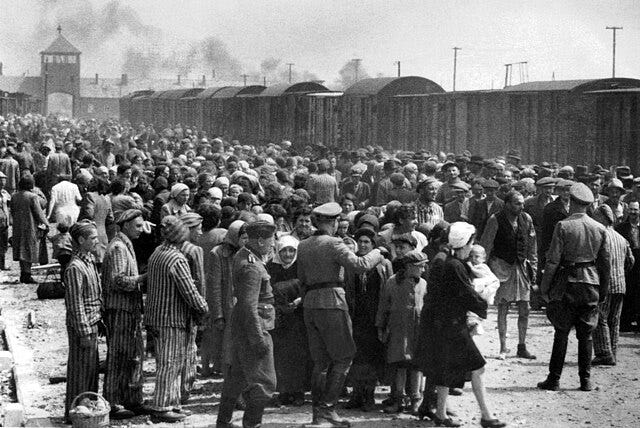
Some of them were terrified, I imagine, to speak up. Some of them were in support of the Nazi agenda. The few who did speak out were punished severely, often brutally. Friends, neighbors, and even family members reported them, leading to devastating consequences.
The brave ones were often arrested by the Gestapo without trial.
Imprisoned. Beaten. Sent to concentration camps.
Fired from jobs. Socially ostracized. Stripped of rights.
Something as small as telling an anti-Hitler joke could send someone to prison.
Often, speaking out was a death sentence.
The state used terror, surveillance, and propaganda to silence dissent.
To be very clear, however, courage wasn’t always such a severe risk. There was a window before the regime had fully consolidated power, when resistance was still possible. Once that consolidation was complete, it was too late. Silence became mandatory for survival.
How did it get to that point?
What were the warning signs in Nazi Germany?
Scapegoating during crisis. Jews, immigrants, and political opponents were blamed for economic hardship and national decline.
“We alone represent the people.” Hitler framed himself as the sole voice of the German people. Anyone who opposed him was labeled anti-German.
Attacks on the press. Before the camps. Before the war. Independent journalism was branded as enemy propaganda.
Normalization of political violence. Nazi paramilitary groups beat political opponents in the streets.
Emergency powers that never ended. After the Reichstag fire in 1933, Hitler declared a national emergency and suspended civil liberties.
Gradual removal of rights. Jews were excluded from professions, barred from marriage, stripped of citizenship, and had their property seized, step by step.
Weaponized nostalgia. The Nazis promised a “return to greatness,” traditional values, and a purified national identity. The future was framed as terrifying. The past was romanticized.
Co-opting institutions instead of destroying them. Courts, police, churches, and universities weren’t abolished. They were filled with loyalists.
Social pressure to conform. Fear kept people silent.
“It can’t happen here” thinking. Many Germans believed Hitler would cool down. That institutions would restrain him. That his rhetoric was just rhetoric.
By the time it was undeniable, it was irreversible.
We are seeing many of these same warning signs in the United States today.
Scapegoating during crisis. Immigrants are blamed for economic hardship and social decline.
“We alone represent the people.” Donald Trump repeatedly frames himself as the only one who can fix the country, while portraying those who oppose him as domestic terrorists.
Attacks on the press. The term “fake news” has been weaponized to undermine trust in independent journalism.
Normalization of political violence. Police and federal law enforcement violence is increasingly justified, minimized, or dismissed, even when civilians are killed.
Emergency powers that threaten permanence. Trump has repeatedly threatened to invoke the Insurrection Act, which would grant sweeping emergency authority.
Gradual removal of rights. Federal protections for reproductive rights have been overturned. LGBTQ and trans rights are increasingly targeted through legislation and policy. After the killing of Alex Pretti by federal agents, Trump told reporters, “You can’t have guns, you can’t walk in with guns,” signaling a willingness to threaten constitutional rights.
Weaponized nostalgia. Make America Great Again promises a return to an idealized past, traditional values, and a purified national identity.
Co-opting institutions instead of destroying them. Courts, law enforcement, churches, and universities are pressured, reshaped, or staffed with loyalists rather than dismantled.
Social pressure to conform. Those who dissent from MAGA ideology are labeled radicals, lunatics, or domestic threats.
“It can’t happen here” thinking. Many Americans believe Trump will calm down. That institutions will stop him. That his rhetoric is simply honesty.
“I think the president being frank and open and honest to your faces, rather than hiding behind your backs, is frankly a lot more respectful than what you saw in the last administration,” Karoline Leavitt said while defending Trump for calling a reporter a “piggy.”
Friends, we are in a rare and fragile moment in American history.
We still have time.
The Trump movement has not fully consolidated power. “We the people” still hold it.
But for Renee Nicole Good and Alex Pretti, it was already too late.
For the countless Black men and women killed by police brutality, it was too late.
For our neighbors suffering in detention centers like the South Texas Family Residential Center in Dilley, Texas, it is too late.
For families ripped apart by immigration policies, it is too late.
It is not too late, however, to save our democracy.
I encourage you to speak out, if for no other reason than to make it safer for others to do so.
This is not the time to worry about the friends we may lose or the connections we may strain. Relationships can be repaired. Democracy cannot.
Hope is not lost.
We still have the power to choose love over fear, truth over propaganda, and community over silence.
We will defeat this.
We will win.
And we will not ignore the piercing whistles of the trains.
Historical Note:
The warning signs outlined in this essay — scapegoating during crisis, attacks on the press, normalization of political violence, emergency powers, and the gradual erosion of civil rights — are widely documented by historians as central to the Nazi consolidation of power in the early 1930s. These patterns are discussed extensively in works by scholars such as Hannah Arendt (The Origins of Totalitarianism), Timothy Snyder (On Tyranny), and Christopher Browning (Ordinary Men). This essay does not argue that the United States is Nazi Germany, but that history provides recognizable patterns of democratic erosion that demand vigilance before power becomes irreversible.